
Introduction
Somalia has faced repeated humanitarian crises driven by drought, conflict, displacement, and fragile health systems. Understanding how these shocks translate into mortality outcomes is essential for timely decision-making and effective humanitarian and public health response. While traditional monitoring systems remain important, they often face limitations in providing continuous, high-resolution insights across time and geography.
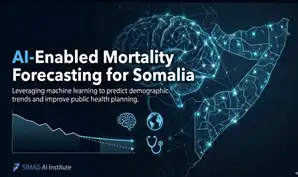
The Somalia AI-Driven Mortality Estimation and Forecasting project applies advanced statistical and Artificial Intelligence (AI) techniques to estimate historical mortality trends and assess future risks. Implemented in collaboration with national and international partners, the project supports evidence-based humanitarian planning, public health policy formulation, and early-warning systems in Somalia.
Explaining the Science
The project integrates machine learning, statistical modeling, and time-series analysis with large-scale humanitarian and public health datasets. These include mortality survey data, climate indicators, displacement dynamics, disease surveillance information, food security metrics, and broader socio-economic variables.
Using AI-assisted analytical and forecasting approaches, the system estimates crude death rates (CDR) and excess mortality at both district and national levels. Scenario-based forecasting enables the exploration of alternative future pathways—optimistic, stable, and adverse—based on evolving risk conditions, supporting anticipatory action and informed policy planning.
Project Aims
The project aims to:
- Generate robust and transparent estimates of mortality trends across Somalia using AI-enabled analytical frameworks
- Provide early-warning forecasts to strengthen humanitarian preparedness and response
- Enhance national capacity for data-driven public health decision-making
- Promote the ethical and responsible use of AI in humanitarian and development contexts
- Contribute to Somalia’s National AI for Public Health and Resilience agenda
Recent Updates
The project is updated on a rolling basis as new SMART surveys and risk-factor datasets become available. Recent developments include extended retrospective mortality estimates, improved population modeling that accounts for displacement dynamics, and refined forecasting scenarios.
Key findings from the latest analyses have been shared with government institutions, humanitarian partners, and international agencies to inform operational planning, resource allocation, and early-action strategies.
How the Project Works
The project combines trusted population data with modern analytical techniques to better understand mortality trends in Somalia. Data from surveys and complementary sources are first organized and quality-checked to ensure consistency and reliability.
Advanced analytical models are then applied to identify temporal patterns and assess how different risk factors influence mortality levels. These models support both retrospective analysis and forward-looking scenario exploration. Results are presented in a clear and responsible manner to inform public health planning.
Researchers and Collaborators
This project is implemented through collaboration between:
- Researchers from SIMAD AI Institute
- Experts from the London School of Hygiene and Tropical Medicine (LSHTM)
- National and international public-health, humanitarian, and data-science partners
The collaboration brings together expertise in epidemiology, AI, statistics, public health, and humanitarian analytics to ensure methodological rigor and policy relevance.